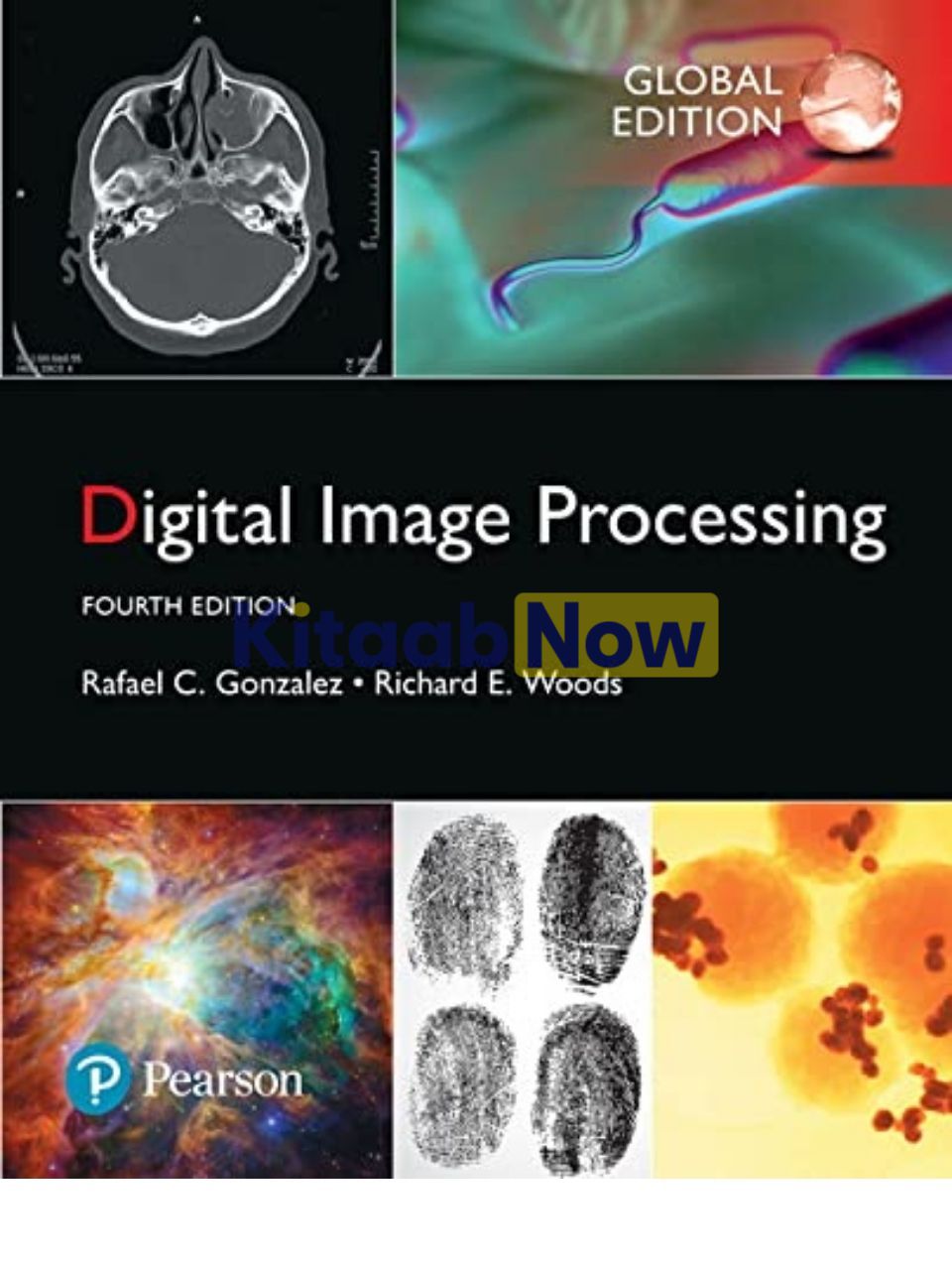
DescriptionFor courses in Image Processing and Computer Vision.Introduce your students to image processing with the industry’s most prized textFor 40 years, Image Processing has been the foundational text for the study of digital image processing. The book is suited for students at the college senior and first-year graduate level with prior background in mathematical analysis, vectors, matrices, probability, statistics, linear systems, and computer programming. As in all earlier editions, the focus of this edition of the book is on fundamentals.The 4th Edition, which celebrates the book’s 40th anniversary, is based on an extensive survey of faculty, students, and independent readers in 150 institutions from 30 countries. Their feedback led to expanded or new coverage of topics such as deep learning and deep neural networks, including convolutional neural nets, the scale-invariant feature transform (SIFT), maximally-stable extremal regions (MSERs), graph cuts, k-means clustering and superpixels, active contours (snakes and level sets), and exact histogram matching. Major improvements were made in reorganizing the material on image transforms into a more cohesive presentation, and in the discussion of spatial kernels and spatial filtering. Major revisions and additions were made to examples and homework exercises throughout the book.Key FeaturesProvide an introduction to basic concepts and methodologies applicable to digital image processingTimely, highly readable, and heavily illustrated with numerous examples of practical significance.NEW! This edition contains 425 new images, 135 new drawings, and 220 new exercises.Focuses on the fundamental material whose scope of application is not limited to the solution of specialized problemsUpdated with feedback from an extensive survey that involved faculty, students, and independent readers of the book in 150 institutions from 30 countries.UPDATED! A complete update of the image pattern recognition chapter to incorporate new material on deep neural networks, backpropagation, deep learning, and, especially, deep convolutional neural networks.EXPANDED! Coverage of feature extraction, including the Scale Invariant Feature Transform (SIFT, maximally stable extremal regions (MSERs), and corner detection.NEW! Coverage of graph cuts and their application to segmentation.NEW! A discussion of superpixels and their use in region segmentation.NEW! An introduction to segmentation using active contours (snakes and level sets).NEW! Material related to exact histogram matching.EXPANDED! Coverage of the fundamentals of spatial filtering, image transforms, and finite differences with a focus on edge detection.Comprehensive support for both students and instructorsAlthough Digital Image Processing is a completely self-contained book, the companion website offers additional support in a number of important areas, including solution manuals, errata sheets, tutorials, publications in the field, a list of books, numerous databases, links to related websites, and many other features that complement the book.NEW! Student Support Package contains all the original images in the book, answers to selected exercises, and instructions for using a set of utility functions that complement the projects.NEW! Faculty Support Package contains solutions to all exercises and projects, teaching suggestions, and all the art in the book in the form of modifiable Powerpoint slides. One support package is made available with every new book, free of charge.New to this EditionAbout this bookA complete update of the image pattern recognition chapter to incorporate new material, including deep neural networks, backpropagation, deep learning, and, especially, deep convolutional neural networks.Expanded coverage of feature extraction, including maximally stable extremal regions, and the Scale Invariant Feature Transform (SIFT).A discussion of superpixels and their use in region segmentation.Coverage of graph cuts and their application to segmentation.New material related to histogram matching.Expanded coverage of the fundamentals of spatial filtering.A more comprehensive and cohesive coverage of image transforms.A more complete presentation of finite differences, with a focus on edge detection.More homework problems at the end of the chapters.More examples.Content updatesChapter 1: Some figures were updated and parts of the text were rewritten to correspond to changes in later chapters.Chapter 2: A new section dealing with random numbers and probability, with an emphasis on their application to image processing. Many sections and examples were rewritten for clarity.Chapter 3: A new section on exact histogram matching, a discussion on separable filter kernels, expanded coverage on the properties of lowpass Gaussian kernels, and highpass, bandreject, and bandpass filters.Chapter 4: Several sections were revised to improve the clarity of presentation.Chapter 5: Clarifications and a few corrections in notation.Chapter 6: Material dealing with color image processing was moved to this chapter. Several sections were clarified, and the explanation of the CMY and CMYK color models was expanded.Chapter 7: A new chapter that brings together wavelets, several new transforms, and many of the image transforms that were scattered throughout the book. The emphasis of this chapter is on a cohesive presentation of these transforms from a unified point of view.Chapter 8: Numerous clarifications and minor improvements to the presentation.Chapter 9: A complete rewrite of several sections, including redrafting of several line drawings.Chapter 10: Several sections were rewritten for clarity. Updated the chapter by adding coverage of finite differences, K-means clustering, superpixels, and graph cuts.Chapter 11: Updated with numerous topics, improvements in the clarity of presentation, added coverage of slope change codes, expanded explanation of skeletons, medial axes, and the distance transform, and new basic descriptors of compactness, circularity, and eccentricity. New material includes coverage of the Harris-Stephens corner detector, and a presentation of maximally stable extremal regions. A major addition to the chapter is a comprehensive discussion dealing with the Scale-Invariant Feature Transform (SIFT).Chapter 123: Now includes coverage of deep convolutional neural networks, an extensive rewrite of neural networks, deep learning, and a comprehensive discussion on fully-connected, deep neural networks that includes derivation of backpropagation starting from basic principles.Table of Contents IntroductionWhat is Digital Image Processing?The Origins of Digital Image ProcessingExamples of Fields that Use Digital Image ProcessingFundamental Steps in Digital Image ProcessingComponents of an Image Processing SystemDigital Image FundamentalsElements of Visual PerceptionLight and the Electromagnetic SpectrumImage Sensing and AcquisitionImage Sampling and QuantizationSome Basic Relationships Between PixelsIntroduction to the Basic Mathematical Tools Used in Digital Image ProcessingIntensity Transformations and Spatial FilteringBackgroundSome Basic Intensity Transformation FunctionsHistogram ProcessingFundamentals of Spatial FilteringSmoothing (Lowpass) Spatial FiltersSharpening (Highpass) Spatial FiltersHighpass, Bandreject, and Bandpass Filters from Lowpass FiltersCombining Spatial Enhancement MethodsFiltering in the Frequency DomainBackgroundPreliminary ConceptsSampling and the Fourier Transform of Sampled FunctionsThe Discrete Fourier Transform of One VariableExtensions to Functions of Two VariablesSome Properties of the 2-D DFT and IDFTThe Basics of Filtering in the Frequency DomainImage Smoothing Using Lowpass Frequency Domain FiltersImage Sharpening Using Highpass FiltersSelective FilteringThe Fast Fourier TransformImage Restoration and ReconstructionA Model of the Image Degradation/Restoration ProcessNoise ModelsRestoration in the Presence of Noise Only—Spatial FilteringPeriodic Noise Reduction Using Frequency Domain FilteringLinear, Position-Invariant DegradationsEstimating the Degradation FunctionInverse FilteringMinimum Mean Square Error (Wiener) FilteringConstrained Least Squares FilteringGeometric Mean FilterImage Reconstruction from ProjectionsColor Image ProcessingColor FundamentalsColor ModelsPseudocolor Image ProcessingBasics of Full-Color Image ProcessingColor TransformationsColor Image Smoothing and SharpeningUsing Color in Image SegmentationNoise in Color ImagesColor Image CompressionWavelet and Other Image TransformsPreliminariesMatrix-based TransformsCorrelationBasis Functions in the Time-Frequency PlaneBasis ImagesFourier-Related TransformsWalsh-Hadamard TransformsSlant TransformHaar TransformWavelet TransformsImage Compression and WatermarkingFundamentalsHuffman CodingGolomb CodingArithmetic CodingLZW CodingRun-length CodingSymbol-based CodingBit-plane CodingBlock Transform CodingPredictive CodingWavelet CodingDigital Image WatermarkingMorphological Image ProcessingPreliminariesErosion and DilationOpening and ClosingThe Hit-or-Miss TransformSome Basic Morphological AlgorithmsMorphological ReconstructionSummary of Morphological Operations on Binary ImagesGrayscale MorphologyImage SegmentationFundamentalsPoint, Line, and Edge DetectionThresholdingSegmentation by Region Growing and by Region Splitting and MergingRegion Segmentation Using Clustering and SuperpixelsRegion Segmentation Using Graph CutsSegmentation Using Morphological WatershedsThe Use of Motion in SegmentationFeature ExtractionBackgroundBoundary PreprocessingBoundary Feature DescriptorsRegion Feature DescriptorsPrincipal Components as Feature DescriptorsWhole-Image FeaturesScale-Invariant Feature Transform (SIFT)Image Pattern ClassificationBackgroundPatterns and Pattern ClassesPattern Classification by Prototype MatchingOptimum (Bayes) Statistical ClassifiersNeural Networks and Deep LearningDeep Convolutional Neural NetworksSome Additional Details of ImplementationBibliographyIndexAuthors BiographyRafael C. Gonzalez received the B.S.E.E. degree from the University of Miami in 1965 and the M.E. and Ph.D. degrees in electrical engineering from the University of Florida, Gainesville, in 1967 and 1970, respectively. He joined the Electrical and Computer Engineering Department at University of Tennessee, Knoxville (UTK) in 1970, where he became Associate Professor in 1973, Professor in 1978, and Distinguished Service Professor in 1984.He is currently a Professor Emeritus at UTK.Gonzalez is the founder of the Image & Pattern Analysis Laboratory and the Robotics & Computer Vision Laboratory at the University of Tennessee.Richard E. Woods earned his B.S., M.S., and Ph.D. degrees in Electrical Engineering from the University of Tennessee, Knoxville. His professional experiences range from entrepreneurial to the more traditional academic, consulting; governmental, and industrial pursuits. Most recently, he founded MedData Interactive, a high technology company specializing in the development of hand-held computer systems for medical applications. He was also a founder and Vice President of Perceptics Corporation.
 – Price range: £27.00 through £32.00