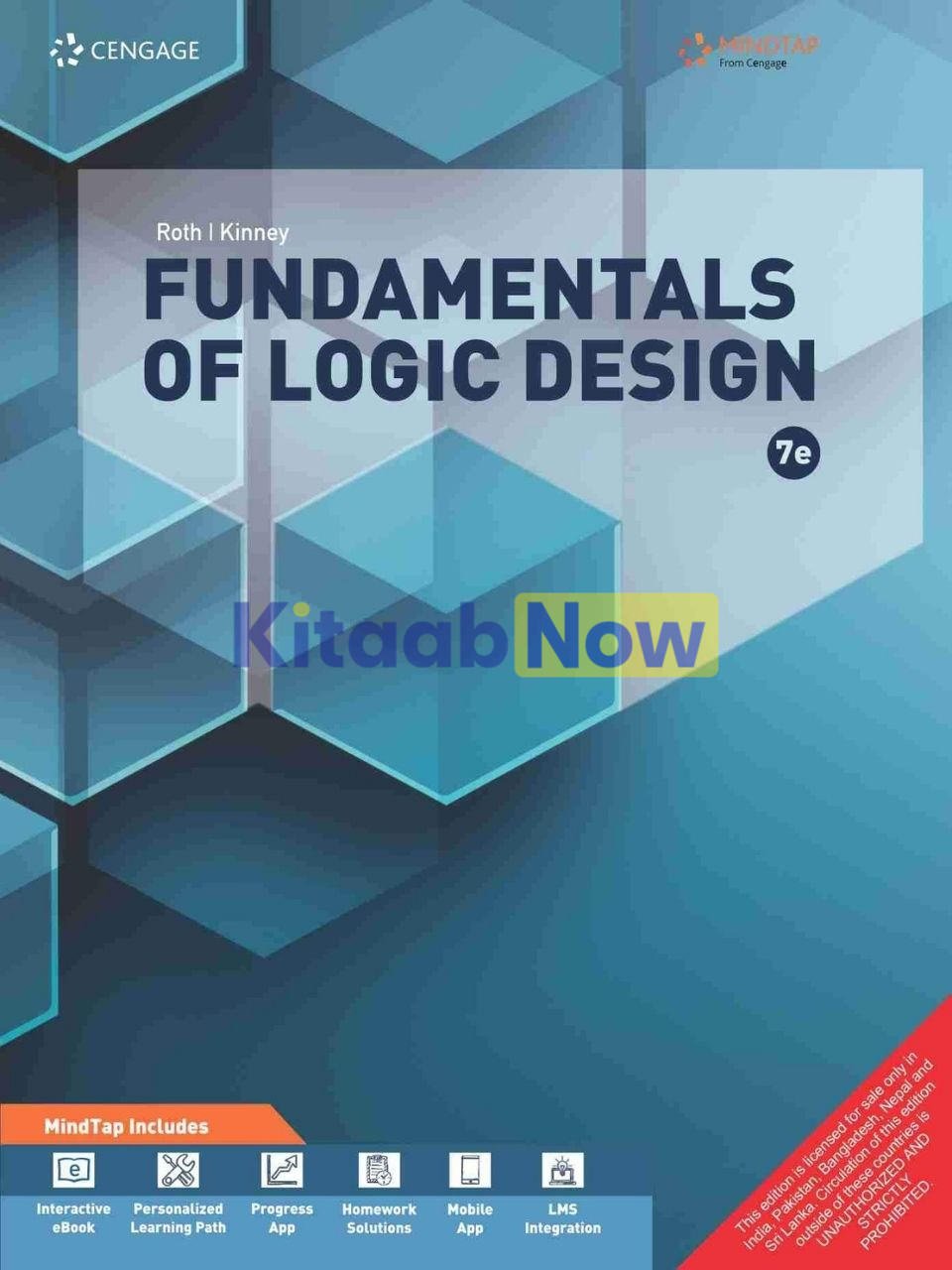
Description‘Updated with modern coverage, a streamlined presentation, and excellent companion software, this seventh edition of FUNDAMENTALS OF LOGIC DESIGN achieves yet again an unmatched balance between theory and application.Authors Charles H. Roth, Jr. and Larry L. Kinney carefully present the theory that is necessary for understanding the fundamental concepts of logic design while not overwhelming students with the mathematics of switching theory. Divided into 20 easy-to-grasp study units, the book covers such fundamental concepts as Boolean algebra, logic gates design, flip-flops, and state machines. By combining flip-flops with networks of logic gates, students will learn to design counters, adders, sequence detectors, and simple digital systems. After covering the basics, this text presents modern design techniques using programmable logic devices and the VHDL hardware description language.Key FeaturesBalances the basic theory of switching circuits and how to apply it providing students with a clear presentation of the key concepts and how to apply them to problems.Contains built-in Self Study Guide at the beginning of each chapter containing reading assignments and study questions which prepare students to make the most of their reading.Includes simulation or laboratory exercises along with specially designed LogicAid and SimuAid design and simulation software that provides opportunities to design a logic circuit and then test its operation.The material on representation of negative numbers has been reorganized allowing the discussions on one”s complement and sign magnitude to be easily omitted if desired.Newly reorganized discussion of switching algebra and Boolean algebra with a more clear distinction of the two.Newly added introduction to asynchronous circuits.NAND and NOR gates are now introduced earlier in the text.New content on carry look-ahead adders has been added.Expanded discussion of hazard detection in Multi-level circuits.Alternative implementations of multiplexers are now given using different types of gates as well as smaller multiplexers to implement larger ones.Content on gated SR latches is now included with an emphasis on input change restrictions and how it relates to hazards. Also included are alternative implementations of gated latches such as the Earle latch.Additional challenging and design-oriented problems have been added to the majority of chapters. Includes Mindtap which is an interactive, customizable and complete learning solution. It includes a MindTap Reader and a library of learning apps (e.g., CNOW, Aplia, ReadSpeaker, Merriam-Webster dictionary, MyContent, RSS Feed, Kaltura, Progress app, etc.)Table of ContentsIntroduction number systems and conversionsBoolean algebraBoolean algebra (continued)Applications of Boolean algebra minterm and maxterm expansionsKarnaugh mapsQuine-McCluskey methodMulti-level gate circuitsCombinational circuit design and simulation using gatesMultiplexers, decoders, and programmable logic devicesIntroduction to VHDLLatches and flip-flopsRegisters and countersAnalysis of clocked sequential circuitsDerivation of state graphs and tablesReduction of state tables state assignmentSequential circuit designVHDL for sequential logicCircuits for arithmetic operationState machine design with SM chartsVHDL for digital system designAuthor(s) DescriptionCharles Roth is Professor Emeritus in Electrical and Computer Engineering at the University of Texas at Austin, where he taught Digital Design for more than four decades. He is the author of Fundamentals of Logic Design, which is in its sixth edition, and Digital Systems Design using VHDL, which is in its second edition.Larry L. Kinney is a Professor and Director of Undergraduate Studies at the University of Minnesota. He received his Ph.D in Electrical Engineering from the University of Iowa in 1968. His research concerns digital system and digital computer design, specifically concurrent error detection techniques, testing of logic and design, distributed computer systems, computer architectures, error detecting/correcting codes, and applications of microprocessors.
 – Price range: £27.00 through £32.00