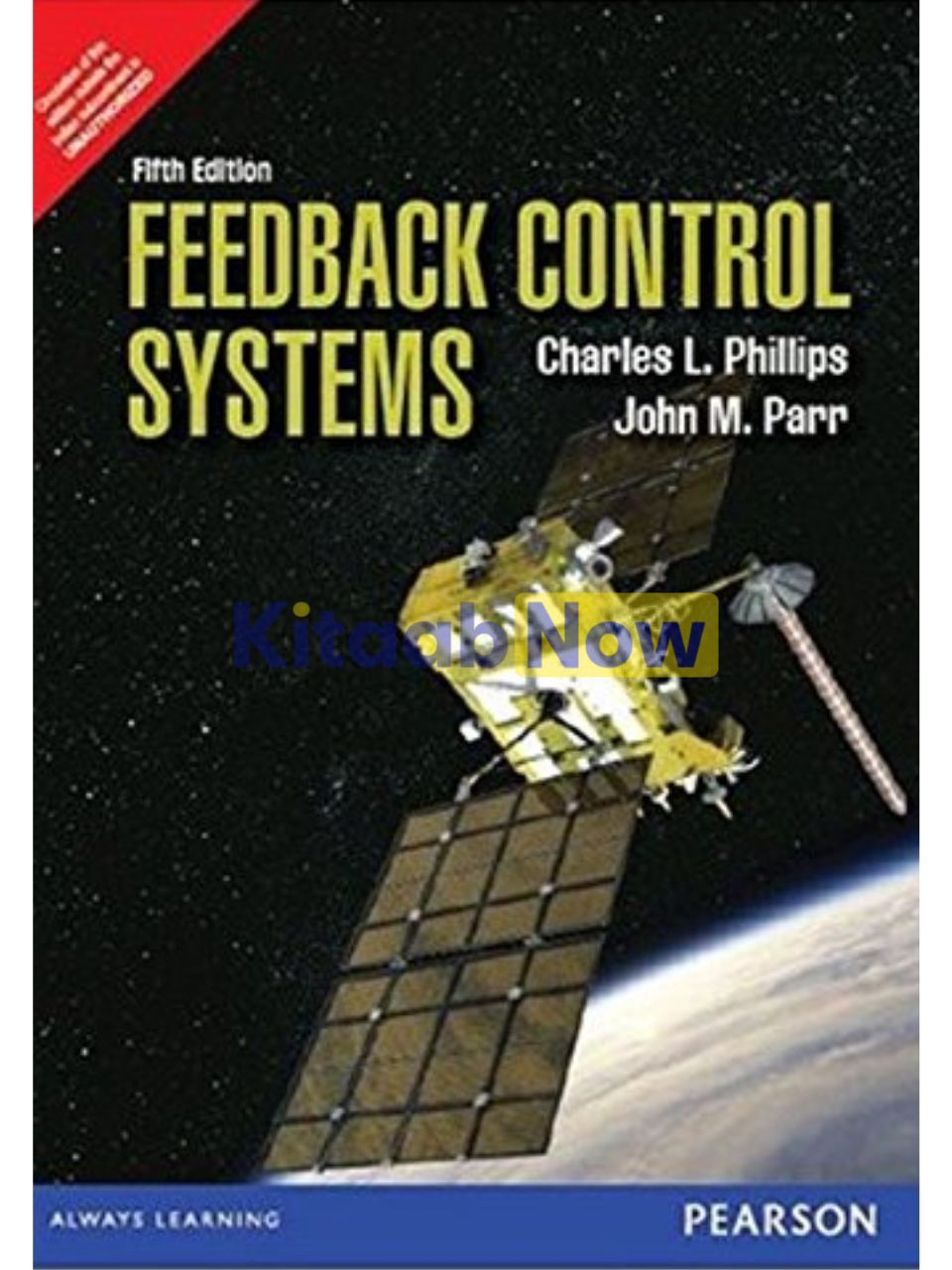
DescriptionFor junior/senior-level Control Theory courses in Electrical, Mechanical, and Aerospace Engineering.For a First Course in Control Systems.Feedback Control Systems, 5th Edition offers a thorough analysis of the principles of classical and modern feedback control in language that can be understood by students and practicing engineers with no prior background in the subject matter. Organized into three sections — analog control systems, digital control systems, and nonlinear analog control systems —this text helps students understand the difference between mathematical models and the physical systems that the models represent.The Fifth edition provides a new introduction to modern control analysis and design for digital systems, the addition of emulation methods of design for digital control, and numerous other updates.Table of ContentsINTRODUCTIONThe Control ProblemExamples of Control SystemsShort History of ControlReferencesMODELS OF PHYSICAL SYSTEMS System ModelingElectrical CircuitsBlock Diagrams and Signal Flow GraphsMasonís Gain FormulaMechanical Translational SystemsMechanical Rotational SystemsElectromechanical SystemsSensorsTemperature-control SystemAnalogous SystemsTransformers and GearsRobotic Control SystemSystem IdentificationLinearizationSummaryReferencesProblemsSTATE-VARIABLE MODELS State-Variable ModelingSimulation DiagramsSolution of State EquationsTransfer FunctionsSimilarity TransformationsDigital SimulationControls SoftwareAnalog SimulationSummaryReferencesProblemsSYSTEM RESPONSES Time Response of First-Order SystemsTime Response of Second-order SystemsTime Response Specifications in DesignFrequency Response of SystemsTime and Frequency ScalingResponse of Higher-order SystemsReduced-order ModelsSummaryReferencesProblemsCONTROL SYSTEM CHARACTERISTICS Closed-loop Control SystemStabilitySensitivityDisturbance RejectionSteady-state AccuracyTransient ResponseClosed-loop Frequency ResponseSummaryReferencesProblemsSTABILITY ANALYSISRouth-Hurwitz Stability CriterionRoots of the Characteristic EquationStability by SimulationSummaryProblemsROOT-LOCUS ANALYSIS AND DESIGN Root-Locus PrinciplesSome Root-Locus TechniquesAdditional Root-Locus TechniquesAdditional Properties of the Root LocusOther ConfigurationsRoot-Locus DesignPhase-lead DesignAnalytical Phase-Lead DesignPhase-Lag DesignPID DesignAnalytical PID DesignComplementary Root LocusCompensator RealizationSummaryReferencesProblemsFREQUENCY-RESPONSE ANALYSIS Frequency ResponsesBode DiagramsAdditional TermsNyquist CriterionApplication of the Nyquist CriterionRelative Stability and the Bode DiagramClosed-Loop Frequency ResponseSummaryReferencesProblemsFREQUENCY-RESPONSE DESIGN Control System SpecificationsCompensationGain CompensationPhase-Lag CompensationPhase-Lead CompensationAnalytical DesignLag-Lead CompensationPID Controller DesignAnalytical PID Controller DesignPID Controller ImplementationFrequency-Response SoftwareSummaryReferencesProblemsMODERN CONTROL DESIGN Pole-Placement DesignAckermannís FormulaState EstimationClosed-Loop System CharacteristicsReduced-Order EstimatorsControllability and ObservabilitySystems with InputsSummaryReferencesProblemsDISCRETE-TIME SYSTEMS Discrete-Time SystemTransform MethodsTheorems of the z-TransformSolution of Difference EquationsInverse z-TransformSimulation Diagrams and Flow GraphsState VariablesSolution of State EquationsSummaryReferencesProblemsSAMPLED-DATA SYSTEMS Sampled DataIdeal SamplerProperties of the Starred TransformData ReconstructionPulse Transfer FunctionOpen-Loop Systems Containing Digital FiltersClosed-Loop Discrete-Time SystemsTransfer Functions for Closed-Loop SystemsState Variables for Sampled-Data SystemsSummaryReferencesProblemsANALYSIS AND DESIGN OF DIGITAL CONTROL SYSTEMS Two ExamplesDiscrete System StabilityJuryís TestMapping the s-Plane into the z-PlaneRoot LocusNyquist CriterionBilinear TransformationRouthñHurwitz CriterionBode DiagramSteady-State AccuracyDesign of Digital Control SystemsPhase-Lag DesignPhase-Lead DesignDigital PID ControllersRoot-Locus DesignSummaryReferencesProblemsDISCRETE-TIME POLE-ASSIGNMENT AND STATE ESTIMATIONIntroductionPole AssignmentState EstimtionReduced-Order ObserversCurrent ObserversControllability and ObservabilitySystems and InputsSummaryReferencesProblemsNONLINEAR SYSTEM ANALYSIS Nonlinear System Definitions and PropertiesReview of the Nyquist CriterionDescribing FunctionDerivations of Describing FunctionsUse of the Describing FunctionStability of Limit CyclesDesignApplication to Other SystemsLinearizationEquilibrium States and Lyapunov StabilityState Plane AnalysisLinear-System ResponseSummaryReferencesProblemsAPPENDICES A – Matrices B – Laplace Transform C – Laplace Transform and z-Transform Tables D – MATLAB Commands Used in This TextE – Answers to Selected ProblemsINDEX Author BiographyProfessor John M. Parr received his Bachelor of Science degree in Electrical Engineering from Auburn University in 1969, an MSEE from the Naval Postgraduate School in 1974, and a PhD in Electrical Engineering from Auburn University in 1988. A retired U.S. Navy Officer, he served as a Program Manager/Project Engineer at Naval Electronic Systems Command in Washington, DC and Officer in Charge – Naval Ammunition Production Engineering Center, Crane, Indiana in addition to sea duty in five ships. Dr. Parr participated in research related to the Space Defense Initiative at Auburn University before joining the faculty at the University of Evansville. Dr. Parr is a co-author of another successful Electrical Engineering textbook, Signals, System and Transforms , by Phillips, Parr and Riskin. He is a registered professional engineer in Indiana, and is a member of the scientific research society Sigma Xi, the American Society of Engineering Educators (ASEE), and a Senior Member of the Institute of Electrical and Electronic Engineers (IEEE).
 – Price range: £27.00 through £32.00